Store keys safely and choose which Projects can use them.
Use a Vault for API keys and other private configuration your Agent needs.
A Project can use a Vault you attach to it; an Agent gets access through its
own workspace and linked Projects.
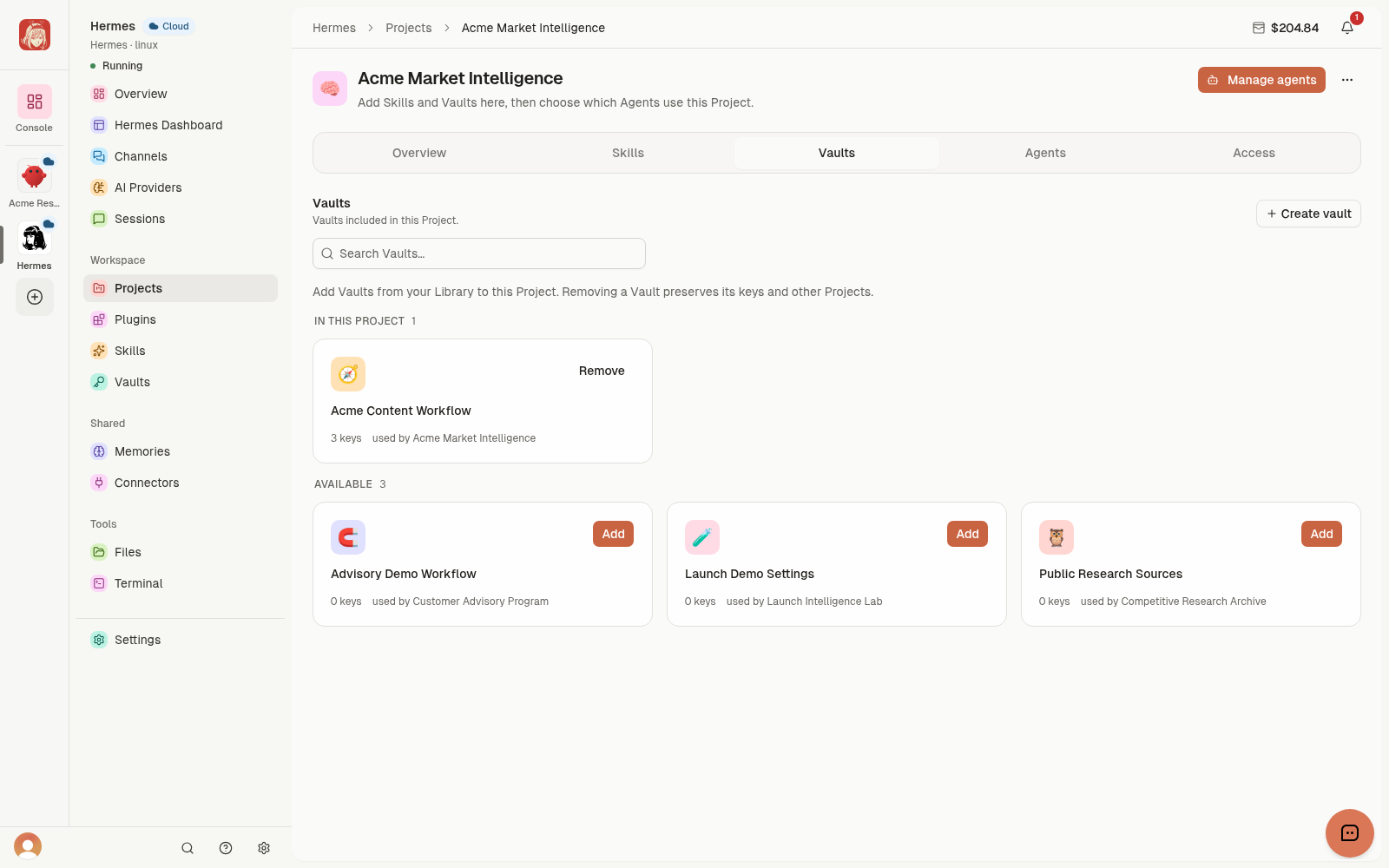
Choose Add beside an available Vault, or Create vault for a new one.
Attach only the Vaults this Project needs.View full-size imageRemoving a Vault from a Project leaves its keys available to other attached
Projects. Changing a shared Vault’s contents affects every Project using it.
Enter the key names and values in the private entry form.
Review the detected keys, then save.
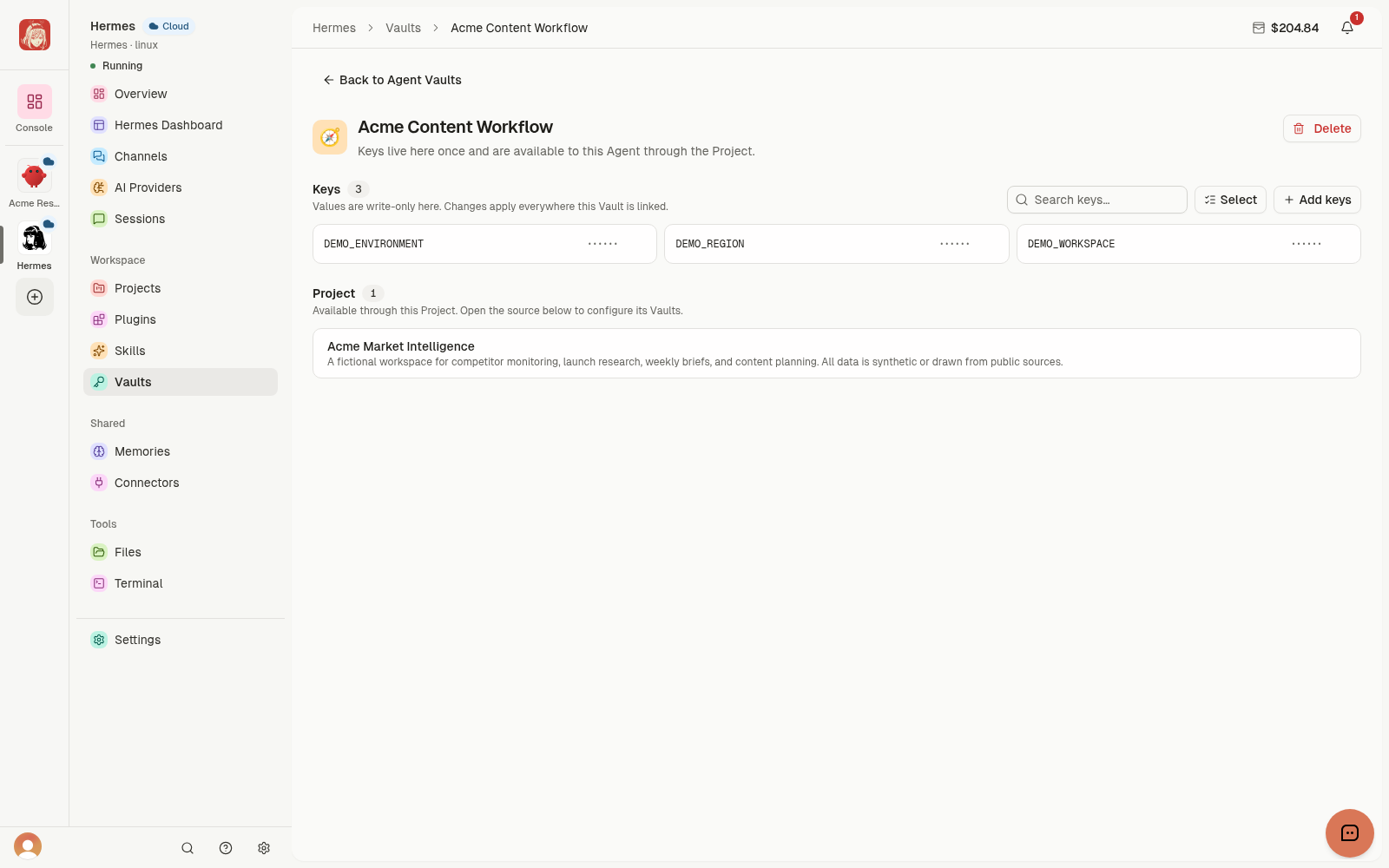
Confirm that the saved key names appear in the Vault.
Saved key names remain visible. Values are write-only in this view.View full-size image
Sharing a Project also gives its Viewers access to attached Vault values
through runtime tools. Masked values in the dashboard still require careful
access control. Review attachments before sharing.
Clawdi manages Vault encryption and can decrypt stored values. Keep secrets
out of conversations, screenshots, and committed files. The advanced steps
below show how to use references when a command or configuration file needs a key.
Advanced: secret references and command-line workflows
The command creates the Vault if needed, stores the value, and prints an exact
reference containing the Project ID. Copy that emitted reference instead of
constructing one by hand.
The import reads valid dotenv identifiers, reports invalid identifiers it
skips, and writes the accepted fields into one Vault section. Existing
plaintext remains in the source file; remove or retain that file according to
your own secret-handling policy after you verify the import.List names and copyable references without printing values:
Exact references carry their Project scope and avoid ambiguous matches when an
Agent has several linked Projects. Project-relative references remain useful
for portable templates, but require an explicit Project, Agent, or linked
folder context at resolution time.To link the current folder to a Project:
clawdi project folder link --project engineeringclawdi project folder status
The CLI creates the output with owner-only permissions and refuses to overwrite
an existing file unless you pass --force explicitly.
An injected file contains plaintext. Keep it out of version control, restrict
access to it, and remove it when the consuming tool no longer needs it.
Writing to stdout can also expose plaintext in terminal logs.
Attaching makes one shared key set available through another Project:
clawdi vault attach payments --project client-app
A later write to that Vault changes the value for every attached Project.
Detach one Project without deleting keys:
clawdi vault detach payments --project client-app
Deleting a key from a Vault attached to multiple Projects affects every one of
them, so the CLI refuses the operation unless you confirm the global effect.
Sharing a Project also gives its Viewers CLI runtime access to Vault values
available through that Project. Review attachments before creating an invite
or share link. See Projects and sharing.
Run clawdi vault --help, clawdi read --help, clawdi run --help, and
clawdi inject --help for version-specific scope and conflict options.